Thursday, 7 June 2012

Yogyakarta–Prambanan Temple

This is the biggest complex of Buddhist/Hindu temples in South East Asia.  The word on the street is that it is best viewed during late afternoon eventually leading to a sunset view across the many many many temples.
We arrived in the rain and it was overcast so a unforgettable sunset was not going to happen.  Having learned from past temples, we decided to hit the temple museum first to get the history of this complex of temples.  Like Borobodor, it had been badly damaged by earthquakes in 2006, and the fact that it was build in 8th century.  All of the smaller temples in the complex were still being rebuilt, but the major ones were mostly whole.  There are 4 main temples in the complex, Sewu, Bubrah, Lumbung and the main one, Prambanan (47m tall).  We watched an audio-visual film explaining the history and the story of the reliefs, the main story is of course Ramayana (Sinta and Rama, the most popular story in Yogyakarta and one we have heard many versions of, an Indonesian Romeo and Juliet!  Rama is the reincarnation of Vishnu)
DSCN1255 (800x600)
1806 photo of the temple
DSCN1365 (800x600)
Andre under a tree of life
DSCN1248 (800x600)
We started at Sewu Temple,built by Hindu King Rakai Pikatan who married a Buddhist princess, this complex has 240 temples surrounding the main one.  All the buildings have a rock fence and a dwarapala (large rock statue armed with a club) guarding the entrance.
DSCN1265 (800x600)DSCN1266 (800x600)DSCN1267 (800x600)DSCN1268 (800x600)DSCN1270 (800x600)DSCN1271 (800x600)DSCN1281 (800x600)DSCN1285 (800x600)DSCN1287 (800x600)
Bubrah Temple
DSCN1296 (800x600)DSCN1298 (800x600)
Lumburg Temple
DSCN1289 (800x600)DSCN1292 (800x600)
Roro Jonggrang Temple (Prambanan temple)
This is made up of 3 main temples (and hundreds around the outside) dedicated to Shiva, Vishnu and Brahma (the biggest is Shiva’s) and the reliefs around each temple tell a story.  The legend behind Roro Jonggrang temple is a powerful man wanted to marry Roro Jonggrang, but she said no unless he built 1000 statues overnight.  He got some Genies to help, but Roro gathered women to beat rice pounders to make a big bonfire to the east so it looked like the sun was rising, the Genies thought it was morning, so they stopped.  Roro went to the man and said you did not complete the task, when he realised what she did, he cursed her to be a Dewi Durga statue.  This final statue bought the total to 1000, as requested!
DSCN1330 (800x600)
Step two three
DSCN1301 (800x600)
The tree of life and the little bird people protecting it and me pointing
DSCN1300 (800x600)DSCN1303 (800x600)DSCN1304 (800x600)DSCN1332 (800x600)DSCN1338 (800x600)DSCN1344 (800x600)DSCN1366 (800x600)DSCN1368 (800x600)DSCN1372 (800x600)DSCN1373 (800x600)DSCN1374 (800x600)DSCN1386 (800x600)DSCN1399 (800x600)DSCN1404 (800x600)DSCN1404a (800x600)
Here is some reliefs and statues from the complex
DSCN1364 (800x600)
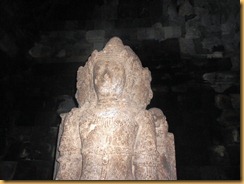
3 faces
DSCN1329 (800x600)
Rama, we think
DSCN1335 (800x600)
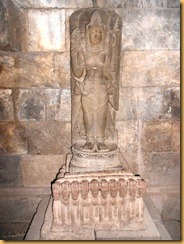
goddess of sun, 7 figures underneath for days of week
DSCN1336 (800x600)
goddess of moon, 10 underneath to show 10 seasons
DSCN1337 (800x600)
the bull that someone rode.......in a nice way!
DSCN1326 (800x600)
figure in middle gave flower to krishna, and recognised him, so he gave her long life etc
DSCN1345 (800x600)
rama making a deal with the monkey army
DSCN1308 (800x600)
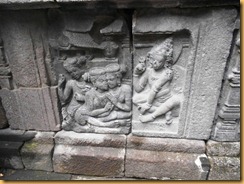
Rama and Sinta married
DSCN1349 (800x600)
youngest brother of Rama who was sleeping, was awakened for a battle,died, and servants covered tomb with flowers
DSCN1348 (800x600)
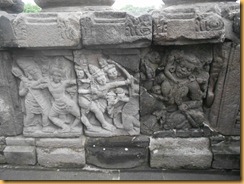
king of monkey army on right, in battle
DSCN1317 (800x600)DSCN1355 (800x600)

Monday, 4 June 2012

adding comments to posts

Hey guys,
We have tested using comments and it seems to work now
1. click comments at the bottom of the post, usually says 0 comment
2. choose profile from drop down box (i would choose anonymous, but sign your name at the end of comment!)
3. preview, that shows what you have written,
4. select publish 
If it doesn't work, please let us know!!!! (by email)

Yogyakarta–Dieng Plateau

The Dieng Plateau is a caldera complex formed by the eruption of ancient Mountain Prau. The caldera was once filled with water but dried up, but volcanic activity continues to this day, with sulphuric fumes and poisonous lakes. Located at an altitude of 2000m, it's also much cooler than the surrounding lowlands.
DSCN1082 (800x600)     DSCN1072 (800x600)     DSCN1074 (800x600)DSCN1075 (800x600)     DSCN1079 (800x600)     DSCN1083 (800x600)
DSCN1085 (800x600)
mirror lake
Between Colourful lake (Telaga Warna, the lake reflects a greenish yellow color, the reflection of the sulfate acid that the lake water contains) and mirror lake, there is Semar Cave with the depth of approximately 4 meters inside. It is used to meditate, beside this cave there are two other caves (although we think we found 4), known as Horse Cave (Goa Jaran) and Water spring Cave (Goa Sumur).  Locals create terraced fields (see later) everywhere they can in dieng, but it was ruining the Lakes so much, and the farmers refused to stop pumping water from the lakes and destroying the forest they eventually had to get the police and army to move them.  although they have managed to sneak back in!
DSCN1087 (800x600)     DSCN1090 (800x600)
DSCN1091 (800x600)     DSCN1097 (800x600)     DSCN1098 (800x600)
Dieng Volcanic Complex (also called the Dieng Plateau) is a complex volcano. A complex volcano is an extensive assemblage of spatially, temporally, and genetically related major and minor volcanic centers with the associated lava flows and pyroclastic rocks.
DSCN1104 (800x600)     DSCN1107 (800x600)     DSCN1110 (800x600)DSCN1118 (800x600)     DSCN1119 (800x600)     DSCN1122 (800x600)DSCN1123 (800x600)     DSCN1124 (800x600)     DSCN1126 (800x600)
The name "Dieng" comes from Di Hyang which means "Abode of the Gods".
The Plateau is the location of eight small Hindu temples. The temples are small shrines built as monuments to the god-ancestors and dedicated to Shiva.  The Hindu shrines are miniature cosmic mountains based on plans in Indian religious texts, although the design motifs have little connection to India.  The earliest architectural usage of the Javanese demonic masks and marine monsters are exhibited along the niches and doorways of the remaining structures.  The Dieng structures were small and relatively plain, but stone architecture developed substantially in only a matter of decades resulting in masterpieces such as the Prambanan complex (not been there….yet) and Borobudur. Built around 750 CE, they are the oldest known standing stone structures in Java, about 50ft high. They are originally thought to have numbered 400 but only eight remain.
DSCN1129 (800x600)     DSCN1131 (800x600)     DSCN1134 (800x600)DSCN1136 (800x600)  DSCN1138 (800x600)  DSCN1139 (800x600)  DSCN1142 (800x600)
There are many terraced fields in Indonesia, but nothing like we saw at Dieng! 
DSCN1081 (800x600)     DSCN1086 (800x600)     DSCN1127 (800x600)